How to Apply for Jobs Abroad From Your Home Country
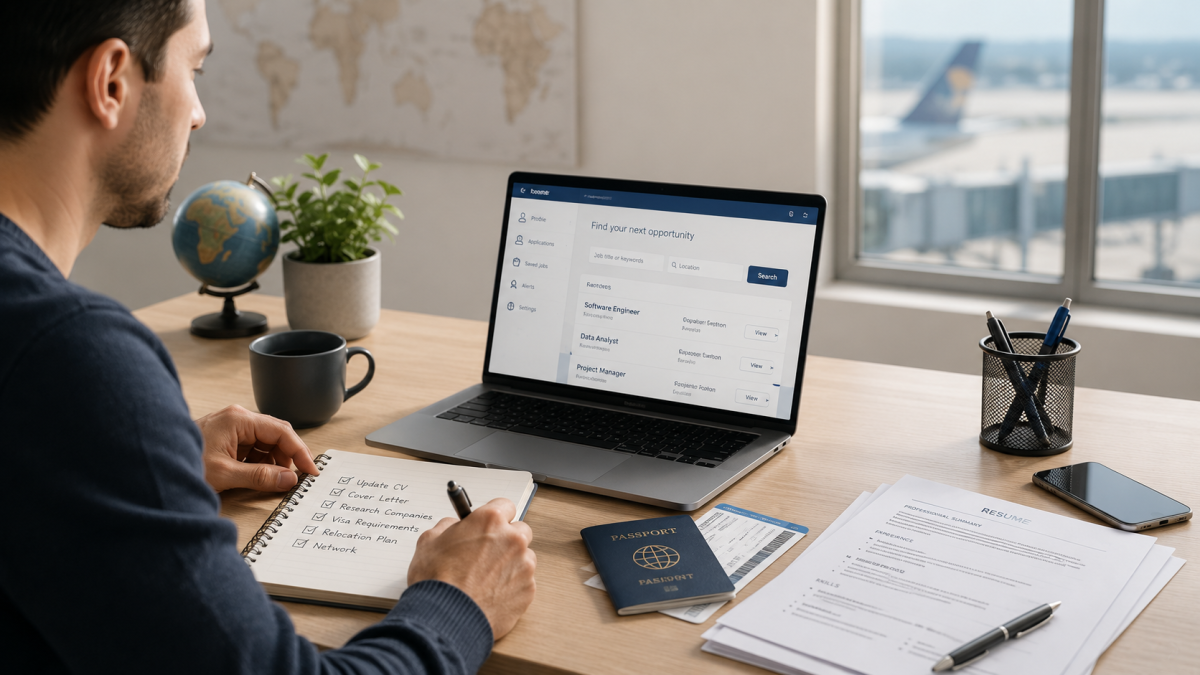
Learning how to apply for jobs abroad from your home country can feel confusing at first.
You may want to work in Canada, Australia, the UK, Germany, Japan, Poland, Slovakia, the UAE, Ireland, New Zealand, or another country.
You may already have a CV.
You may already have experience.
You may already be searching job boards every night.
But then the same questions appear again and again.
Which jobs are open to foreign applicants?
Which employers sponsor visas?
Should you apply directly or use an agent?
How do you write a CV for overseas employers?
How do you avoid scams?
What should you say in your email?
How do you follow up without sounding desperate?
That is why this guide exists.
This is a practical step-by-step guide on how to apply for jobs abroad from your home country without wasting time, applying randomly, or trusting suspicious recruiters.
For job seekers from Indonesia, India, Nigeria, South Africa, Kenya, Pakistan, the Philippines, Bangladesh, Ghana, Nepal, Sri Lanka, and other developing countries, international job applications can be life-changing.
But the process must be serious.
A good overseas job search is not based on panic.
It is based on research, documents, official sources, employer verification, strong applications, and patience.
You can also explore global job ideas through ISKCON of Escondido Jobs while using this guide to build a safer and smarter international job search system.
Why you should learn how to apply for jobs abroad properly
Many people want to apply for jobs abroad, but not everyone understands how international hiring works.
Applying abroad is different from applying locally.
A local employer may only need to check your CV, interview you, and give you a start date.
An overseas employer may need to think about:
- Your current country
- Your passport
- Your visa eligibility
- Your work authorization
- Your qualifications
- Your language ability
- Your documents
- Your relocation timeline
- Your salary expectation
- Your ability to adapt
- Whether the role can legally hire a foreign worker
- Whether sponsorship is possible
- Whether the employer has time and budget for international hiring
That means your application must reduce doubt.
A strong international application should make the employer think:
This person is serious, qualified, organized, and worth considering.
That is the goal.
The biggest mistake when people apply for jobs abroad
The biggest mistake is applying everywhere with no strategy.
Many applicants open job boards and search:
- Canada jobs
- Australia jobs
- UK jobs
- Europe jobs
- Japan jobs
- visa sponsorship jobs
- no degree jobs abroad
- factory jobs abroad
- hotel jobs abroad
Then they send the same CV to hundreds of employers.
This usually fails.
Why?
Because international hiring is not just about volume.
You need fit.
You need the right country, right role, right employer, right visa route, right documents, and right message.
If you want to apply for jobs abroad successfully, you need a system.
Step 1: Choose one country before you apply for jobs abroad
Before you apply, choose one main country.
Do not start with ten countries at once.
A focused search is stronger.
For example, choose:
- Canada
- Australia
- United Kingdom
- Germany
- Japan
- Poland
- Slovakia
- Ireland
- New Zealand
- UAE
- Netherlands
- Sweden
Each country has different rules.
Canada may involve Job Bank, LMIA, work permits, Express Entry, or Provincial Nominee Programs.
Australia may involve occupation lists, Skills in Demand visa, English tests, employer sponsorship, or skills assessment.
The UK may involve licensed sponsors, eligible occupation codes, salary thresholds, and Skilled Worker visa rules.
Germany may involve skilled worker routes, vocational recognition, Opportunity Card, or German language.
Japan may involve Specified Skilled Worker, professional work categories, and Japanese language tests.
Europe is not one country. Poland, Slovakia, Germany, Sweden, Austria, and Ireland all have different systems.
Choose one country first so your research becomes clear.
Step 2: Choose one target role before you apply for jobs abroad
After choosing a country, choose one target role.
Do not apply as “anything.”
Employers do not sponsor “anything.”
They hire specific people for specific jobs.
Choose a target such as:
- Care worker
- Nurse
- Software developer
- Data analyst
- Warehouse worker
- Factory worker
- Machine operator
- Cook
- Chef
- Hotel worker
- Customer support specialist
- Truck driver
- Electrician
- Welder
- Carpenter
- Mechanical technician
- Farm worker
- Construction worker
- Teacher
- Engineer
- Digital marketer
- Accountant
Your target role should match your real background.
If you have warehouse experience, focus on warehouse and logistics roles.
If you have customer support experience, focus on support, BPO, customer success, or helpdesk roles.
If you have IT experience, focus on software, cloud, data, support, cybersecurity, or technical roles.
If you have hospitality experience, focus on hotel, restaurant, kitchen, housekeeping, or guest service roles.
To apply for jobs abroad effectively, your role must be clear.
Step 3: Check whether your target job can hire foreigners
This is the step many applicants skip.
Not every job abroad is open to foreign applicants.
Some jobs are only for citizens, permanent residents, or people who already have local work rights.
Some jobs can sponsor foreign workers.
Some jobs cannot.
Some jobs require a licensed employer.
Some jobs require an occupation code.
Some jobs require a salary threshold.
Some jobs require language tests or professional registration.
Before applying, check:
- Is the occupation eligible?
- Can employers sponsor this role?
- Is the salary high enough?
- Does the role need a licence?
- Does the role need a degree?
- Does the role accept vocational experience?
- Does the country accept applicants from outside?
- Does the employer mention sponsorship?
- Does the job board show foreign candidate eligibility?
For Canada, the official Job Bank foreign candidates page is useful because it focuses on jobs open to international candidates from outside Canada.
For the UK, the official GOV.UK Register of Licensed Sponsors helps applicants check whether an employer is licensed to sponsor workers.
For Europe, EURES can help jobseekers research jobs and mobility information across Europe.
When you apply for jobs abroad, official sources should come before random social media posts.
Step 4: Build your document checklist before you apply for jobs abroad
International job applications need documents.
Some documents are needed before applying.
Some are needed after interview.
Some are needed only after a job offer.
But you should prepare early.
Common documents include:
- Passport
- Updated CV
- Cover letter
- Employment letters
- Education certificates
- Training certificates
- Skills certificates
- Professional licence, if required
- Language test results
- Police certificate, if required
- Medical exam, if required
- References
- Portfolio, if relevant
- LinkedIn profile
- GitHub, if relevant
- Driving licence, if relevant
- Trade certificates, if relevant
- Proof of funds, if required
- Translated documents, if required
A serious employer may move quickly.
If your documents are messy, you may lose the opportunity.
When you apply for jobs abroad, document readiness makes you look more professional.
Step 5: Create an international CV before you apply for jobs abroad
Your CV must be clear to an overseas employer.
Do not assume they understand your local company, school, job title, or industry.
A strong international CV should include:
- Full name
- City and country
- Phone number with country code
- Professional headline
- Short summary
- Key skills
- Work experience
- Education
- Certifications
- Languages
- Tools and systems
- Relocation note, when useful
The UK National Careers Service says a CV should include sections such as contact details, an introduction, education history, work history, and references. The official Europass CV builder can also help applicants create a CV for jobs, education, training, and volunteering opportunities in Europe.
For international jobs, your CV should be achievement-based.
Weak CV bullet:
Worked in customer service.
Better CV bullet:
Handled 60+ customer inquiries per day through email and chat while maintaining 94% customer satisfaction.
Weak CV bullet:
Worked in warehouse.
Better CV bullet:
Picked, packed, and scanned 180+ orders per shift with 98% inventory accuracy.
Weak CV bullet:
Helped team.
Better CV bullet:
Trained 8 new team members on workflow, safety rules, and quality standards.
When you apply for jobs abroad, your CV should show proof, not just duties.
Step 6: Write a professional relocation note
A relocation note can help, but it must sound professional.
Do not write:
Please sponsor me. I need visa. I can do anything.
Write:
Currently based in Indonesia and open to relocation for eligible employer-sponsored roles.
Or:
Available for international relocation with proper work authorization support.
Or:
Open to overseas opportunities in Canada, Australia, the UK, Europe, or Japan where my experience matches employer and visa requirements.
This shows seriousness without sounding desperate.
When you apply for jobs abroad, never make the employer feel like your only value is needing a visa.
Show skills first.
Mention relocation professionally.
Step 7: Make your LinkedIn match your CV
Many overseas recruiters will check LinkedIn.
Your LinkedIn should match your CV.
Update:
- Profile photo
- Headline
- About section
- Work experience
- Skills
- Certifications
- Location
- Contact information
- Portfolio links
- Featured projects
- Recommendations, if possible
Your LinkedIn headline should be specific.
Weak headline:
Looking for job abroad
Better headline:
Customer Support Specialist | Zendesk, Shopify, E-commerce Support | Open to International Roles
Another example:
Software Developer | Python, Node.js, AWS | Backend APIs and Automation
Another example:
Warehouse Operator | Inventory Control, Picking, Packing, Safety Compliance
When you apply for jobs abroad, your online profile should confirm your credibility.
Step 8: Build a verified employer list before you apply for jobs abroad
Do not wait for recruiters to find you.
Build your own employer list.
Use a spreadsheet with columns like:
- Country
- Company name
- Website
- Industry
- Job title
- Job link
- Employer email
- Sponsorship status
- Salary
- Location
- Application date
- Follow-up date
- Response
- Red flags
- Notes
This helps you avoid chaos.
It also helps you identify patterns.
For example:
- Which employers respond?
- Which job titles fit your background?
- Which countries are too difficult?
- Which applications get ignored?
- Which recruiters look suspicious?
- Which documents are missing?
A serious job search needs tracking.
When you apply for jobs abroad, your spreadsheet becomes your control center.
Step 9: Use official job portals first
Job boards are useful, but official or reputable portals are safer starting points.
Examples include:
- Job Bank Canada foreign candidates
- EURES jobseekers portal
- European Job Days
- Official government job portals
- Public employment service portals
- Company career pages
- Licensed sponsor lists
- Embassy or government guidance pages
For broader research, you can also browse ISKCON of Escondido Jobs and then verify every opportunity through official sources.
When you apply for jobs abroad, never rely on one source.
Use several sources and compare.
Step 10: Use job boards carefully when you apply for jobs abroad
Popular job boards can help, but they also include jobs that may not be open to foreign applicants.
Before applying, check:
- Does the job accept overseas applicants?
- Does it mention sponsorship?
- Does it require existing work rights?
- Is the employer name visible?
- Is the salary realistic?
- Is the location clear?
- Are the duties specific?
- Is the job posted on the company website too?
- Is the recruiter using a real company email?
- Does the role match your experience?
Be careful with job posts that say:
- Visa guaranteed
- No interview needed
- No experience needed
- No documents needed
- Pay first
- Employer confidential
- Salary very high for simple work
- Apply only through WhatsApp
- Work permit in a few days
A job board listing is not proof.
Verification is still required.
Step 11: Apply directly on company career pages
Company career pages are often safer than random third-party posts.
Search for employers in your target sector.
For example:
Healthcare:
- Hospitals
- Care homes
- Home care providers
- Clinics
- Aged care companies
- Disability support providers
IT:
- Software companies
- SaaS companies
- Cloud service providers
- Cybersecurity firms
- Digital agencies
- Tech consultancies
Hospitality:
- Hotels
- Resorts
- Restaurant groups
- Cruise-adjacent hospitality employers
- Catering companies
Manufacturing and logistics:
- Factories
- Food processing companies
- Warehouses
- Distribution centers
- Supply chain companies
- Transport companies
Construction and trades:
- Construction firms
- Engineering contractors
- Maintenance companies
- Infrastructure firms
When you apply for jobs abroad directly, you reduce the risk of fake recruiters and hidden employers.
Step 12: Customize every application
Do not send the same CV everywhere.
Customize your CV and message for each role.
You do not need to rewrite everything.
But you should adjust:
- Professional headline
- Summary
- Key skills
- First few bullet points
- Tools
- Certifications
- Country-specific terms
- Cover letter
- Email message
Match the job description honestly.
If the job asks for inventory control, show your inventory experience.
If the job asks for elderly care, show your care experience.
If the job asks for Python and AWS, show projects using Python and AWS.
If the job asks for hotel guest service, show guest service achievements.
When you apply for jobs abroad, relevance matters more than volume.
Step 13: Write a clean email message
A short professional email can help.
Use this structure:
Subject:
Application for [Job Title] – [Your Name]
Email body:
Dear Hiring Team,
I am applying for the [Job Title] role. I have [X years] of experience in [field], including [specific skill or achievement]. I am currently based in [country] and open to relocation for eligible roles with proper work authorization support.
I have attached my CV for your review. I would be glad to discuss how my background matches your hiring needs.
Kind regards,
[Your Name]
Example:
Dear Hiring Team,
I am applying for the Warehouse Operator role. I have 4 years of experience in picking, packing, barcode scanning, inventory control, and shift-based operations. I processed 180+ orders per shift with strong accuracy and safety compliance. I am currently based in Indonesia and open to relocation for eligible roles with proper work authorization support.
I have attached my CV for your review. I would be glad to discuss how my background matches your hiring needs.
Kind regards,
Rachman
When you apply for jobs abroad, your message should sound calm and professional.
Step 14: Write a short cover letter
A cover letter is not always required, but it can help when applying internationally.
Use a simple structure:
Paragraph 1: role and interest
Paragraph 2: relevant experience
Paragraph 3: relocation readiness and documents
Paragraph 4: polite closing
Example:
Dear Hiring Manager,
I am applying for the Customer Support Specialist position. I have four years of experience supporting e-commerce customers through email, live chat, and CRM platforms.
In my previous role, I handled 60+ tickets per day, supported refunds and order issues, and maintained a 94% customer satisfaction score. I also trained new agents on escalation handling and tone-of-voice standards.
I am currently based in Indonesia and open to relocation for eligible employer-supported roles. I am prepared to provide employment references, certificates, and other documents required for the hiring process.
Thank you for your time and consideration. I would welcome the opportunity to discuss how my experience matches your team’s needs.
Kind regards,
[Your Name]
When you apply for jobs abroad, the cover letter should explain your value, not beg for relocation.
Step 15: Prepare for international interviews
If you get an interview, prepare carefully.
International interviews often test more than technical skills.
Employers may ask:
- Why do you want to work in this country?
- Why are you applying from overseas?
- Do you understand the visa process?
- When can you relocate?
- What documents do you have ready?
- What salary do you expect?
- Are you willing to work shifts?
- Do you understand local workplace culture?
- Can you communicate clearly in English or another required language?
- Why should we hire you instead of a local applicant?
Prepare answers with proof.
Do not say:
I want to move because life is hard here.
Say:
I am looking for international growth in a role that matches my experience. I have four years of relevant background, strong documentation, and I am prepared for the relocation process if selected for an eligible role.
When you apply for jobs abroad, your interview should show maturity.
Step 16: Explain your visa situation clearly
You do not need to be an immigration expert.
But you should understand the basics.
For example:
For Canada:
I understand many foreign candidates may require an employer-specific work permit or LMIA-supported process depending on the role.
For the UK:
I understand the role would need to meet Skilled Worker requirements and the employer must be licensed to sponsor if sponsorship is needed.
For Australia:
I understand employer sponsorship may depend on the visa subclass, occupation, salary, and eligibility requirements.
For Europe:
I understand work authorization and residence routes depend on the country and employer process.
Do not pretend you already have work rights if you do not.
Be honest.
When you apply for jobs abroad, clarity builds trust.
Step 17: Follow up properly after applying
A polite follow-up can help.
Wait around 7 to 10 business days unless the job post says otherwise.
Example:
Dear Hiring Team,
I hope you are well. I am following up on my application for the [Job Title] role submitted on [date]. I remain very interested in the opportunity and believe my experience in [specific area] matches the role requirements.
Please let me know if any additional information is needed.
Kind regards,
[Your Name]
Do not send daily messages.
Do not beg.
Do not pressure the recruiter.
When you apply for jobs abroad, professionalism matters even when you are waiting.
Step 18: Track every application
Use a spreadsheet.
Track:
- Date applied
- Company
- Country
- Job title
- Job link
- Contact person
- Email used
- Salary
- Sponsorship mention
- Status
- Follow-up date
- Interview date
- Documents requested
- Red flags
This helps you stay organized.
It also protects you from scams.
If someone contacts you later, you can check whether you actually applied.
Scammers sometimes pretend to represent companies you never contacted.
When you apply for jobs abroad, tracking helps you stay in control.
Step 19: Verify every recruiter
Before sharing sensitive documents, verify the recruiter.
Check:
- Full name
- Company email
- LinkedIn profile
- Company website
- Job posting
- Employer identity
- Phone number
- Interview process
- Whether the recruiter can explain the visa route
- Whether the recruiter asks for suspicious payments
Be careful with recruiters using only:
- Telegram
- Gmail
- Yahoo
- Outlook
- Fake domains
- No video calls
- No company website
- No written job details
Some small recruiters are legitimate, but you should still verify.
When you apply for jobs abroad, trust must be earned.
Step 20: Never pay for a guaranteed job
This is one of the most important rules.
The official consumer.gov job scam guidance says scammers may promise a job but ask you to pay first, and that if someone asks you to pay to get a job, that is a scam.
Be careful if someone asks for money for:
- Guaranteed job
- Guaranteed visa
- Guaranteed sponsorship
- Interview slot
- Job reservation
- Fake contract
- Fake employer letter
- LMIA purchase
- Certificate of Sponsorship purchase
- Work permit purchase
- Fake experience letter
- Fake bank statement
- Fake language certificate
Real processes can include official fees, document translation, medical exams, police certificates, tests, or visa application fees.
But those costs should be clear, legal, documented, and verifiable.
When you apply for jobs abroad, never pay because someone pressures you.
Step 21: Check salary and cost of living
A salary abroad can look high from your home country.
But you must compare it with local costs.
Check:
- Gross salary
- Net salary after tax
- Rent
- Utilities
- Food
- Transport
- Health insurance
- Phone plan
- Work clothes
- Visa fees
- Flights
- Remittance needs
- Emergency savings
- Accommodation deductions
- Overtime rules
- Contract length
A job that pays more may still leave you with less savings if the city is expensive.
When you apply for jobs abroad, think like an adult with bills, not like a tourist.
Step 22: Check the contract carefully
Before accepting an overseas job, review the contract.
A serious contract should include:
- Employer name
- Job title
- Work location
- Salary
- Working hours
- Contract duration
- Duties
- Probation period
- Leave
- Overtime rules
- Accommodation, if provided
- Deductions
- Benefits
- Start date
- Termination rules
- Visa support details
- Employer contact details
Be careful if someone says:
- Contract after payment
- Details after arrival
- Employer confidential
- No need contract
- Trust us
- Work first, contract later
When you apply for jobs abroad, the contract is protection.
Step 23: Prepare for rejection
Rejection is normal.
International hiring is competitive.
You may apply to 50 jobs and hear back from only a few.
That does not always mean you are bad.
It may mean:
- Your CV is weak
- Your target country is too difficult
- Your role does not sponsor
- Your salary level does not match
- You need stronger English
- You need better documents
- Your occupation is not eligible
- Employers prefer local candidates
- You are applying to the wrong job boards
- Your experience is not clear enough
Use rejection as data.
When you apply for jobs abroad, improvement matters more than emotion.
Step 24: Improve one thing every week
Do not panic.
Improve systematically.
Every week, improve one area:
- CV
- Cover letter
- English
- Certifications
- Job targeting
- Employer list
- Interview answers
- Portfolio
- Reference letters
- Country research
- Visa understanding
Small improvements compound.
A stronger CV plus better targeting plus cleaner documents can produce better results over time.
Best countries to apply for jobs abroad from home
There is no single best country for everyone.
But these countries are worth researching depending on your profile.
Apply for jobs abroad in Canada
Canada can be interesting for applicants researching:
- LMIA-supported jobs
- Employer-specific work permits
- Job Bank foreign candidate listings
- Express Entry
- Provincial Nominee Programs
- Caregiver routes
- Agriculture
- Food processing
- Healthcare
- IT
- Skilled trades
- Logistics
Use the official Job Bank foreign candidates page to search jobs open to international candidates.
Canada can be realistic, but scams are common because many people want Canadian permanent residence.
Verify everything.
Apply for jobs abroad in Australia
Australia can be interesting for applicants researching:
- Employer sponsorship
- Skills in Demand visa
- Skilled occupation list
- Regional jobs
- Healthcare
- Aged care
- IT
- Engineering
- Trades
- Hospitality
- Agriculture
Before applying, check whether your occupation is eligible and whether the employer can sponsor.
Australia can be strong for skilled applicants, but English, occupation codes, and documents matter.
Apply for jobs abroad in the UK
The UK can be interesting for applicants researching:
- Skilled Worker visa
- Licensed sponsor employers
- Healthcare
- Care roles
- IT
- Engineering
- Education
- Science
- Professional roles
Use the official GOV.UK Register of Licensed Sponsors to check whether an employer is licensed.
But remember: being on the sponsor list does not mean every job sponsors.
Check the specific vacancy.
Apply for jobs abroad in Europe
Europe is broad.
Countries such as Germany, Poland, Slovakia, Ireland, Sweden, Austria, Netherlands, Czechia, Lithuania, and Portugal have different rules.
Use EURES to research jobs and European mobility information.
Europe may be strong for:
- IT
- Engineering
- Healthcare
- Manufacturing
- Logistics
- Skilled trades
- Hospitality
- Research
- Technical roles
Do not treat Europe as one visa system.
Each country has its own immigration rules.
Apply for jobs abroad in Japan
Japan can be interesting for applicants researching:
- Specified Skilled Worker
- Engineer/Specialist roles
- Highly Skilled Professional
- Manufacturing
- Food service
- Nursing care
- Hospitality
- IT
- Construction
- Agriculture
Japanese language can matter a lot.
For Japan, do not ignore language tests, skills tests, and official visa categories.
Apply for jobs abroad in the UAE
The UAE can be interesting for applicants researching:
- Hospitality
- Retail
- Sales
- Logistics
- Aviation support
- Customer service
- Construction
- Real estate support
- Finance operations
- IT
- Administration
The UAE job market can move quickly, but applicants must verify contracts, salary, visa status, and employer legitimacy.
Do not work on a visa that does not allow work.
Best websites to use when you apply for jobs abroad
Useful sources include:
- Official government job portals
- Company career pages
- Public employment service portals
- EURES for Europe
- Job Bank for Canada
- Licensed sponsor registers
- Embassy guidance pages
- Professional association websites
- Reputable job boards
- Employer websites
For broader research, use ISKCON of Escondido Jobs and then verify country-specific rules through official sources.
The safest strategy is not one website.
It is cross-checking.
Best search keywords to apply for jobs abroad
Use targeted keywords.
Examples:
- apply for jobs abroad
- jobs abroad for foreigners
- visa sponsorship jobs abroad
- overseas jobs for foreigners
- international jobs with visa sponsorship
- jobs abroad from home country
- Canada jobs for foreign candidates
- Australia visa sponsorship jobs
- UK licensed sponsor jobs
- Europe jobs for foreigners
- Germany jobs for non-EU applicants
- Japan SSW jobs
- warehouse jobs abroad for foreigners
- caregiver jobs abroad
- IT jobs abroad with sponsorship
- hospitality jobs abroad
But remember:
Search keywords only help you find opportunities.
Verification helps you avoid bad ones.
Common mistakes when you apply for jobs abroad
Avoid these mistakes.
Mistake 1: applying without checking visa rules
A job may not support a work visa.
Check first.
Mistake 2: using a weak CV
A vague CV is easy to ignore.
Add numbers, tools, achievements, and clear experience.
Mistake 3: sounding desperate
Employers hire value.
Do not make your entire message about needing sponsorship.
Mistake 4: trusting WhatsApp-only recruiters
A real recruiter should be verifiable.
Mistake 5: paying before verification
Never pay for guaranteed jobs or hidden employer offers.
Mistake 6: applying to every country at once
Focus creates better applications.
Mistake 7: ignoring English or language skills
Language can affect interviews, visa eligibility, and workplace safety.
Mistake 8: not tracking applications
Without tracking, you lose control.
Mistake 9: lying about experience
Fake documents can damage your future.
Mistake 10: ignoring cost of living
A high salary abroad is not always high after rent, tax, and deductions.
30-day plan to apply for jobs abroad from home
Use this practical plan.
Days 1–3: choose one country
Pick one target country.
Write down why that country fits your profile.
Days 4–6: choose one job target
Pick one role based on your real experience.
Do not apply as “anything.”
Days 7–10: research visa basics
Use official sources.
Write down:
- Visa route
- Employer role
- Salary rule
- Occupation eligibility
- Documents
- Language requirements
- Scam warnings
Days 11–14: fix your CV
Create an international CV.
Add:
- Summary
- Skills
- Achievements
- Tools
- Numbers
- Certifications
- Language ability
- Relocation note
Days 15–17: update LinkedIn
Make your LinkedIn match your CV.
Add a professional headline and clear experience.
Days 18–21: build employer list
Find 30 to 50 employers.
Use company websites, official portals, and reputable job boards.
Days 22–25: apply carefully
Send targeted applications.
Customize each CV or message.
Track everything.
Days 26–28: follow up
Send polite follow-up messages to selected employers.
Do not spam.
Days 29–30: review and improve
Check:
- Which jobs got responses?
- Which employers ignored you?
- Which CV version worked better?
- Which documents are missing?
- Which country looks most realistic?
- Which skills need improvement?
Then repeat the system.
Is it worth it to apply for jobs abroad?
Yes, it can be worth it.
But only when you apply properly.
It may be worth it when:
- Your skills match demand
- Your CV is strong
- Your documents are ready
- You understand the visa route
- You verify employers
- You avoid fake recruiters
- You apply consistently
- You improve after rejection
- You are patient
- You use official sources
It may not be worth it when:
- You want instant relocation
- You apply randomly
- You trust every recruiter
- You pay for promises
- You refuse to improve your CV
- You ignore visa rules
- You do not check contracts
- You use fake documents
- You have no clear job target
To apply for jobs abroad well, you need strategy, not desperation.
Final thoughts on how to apply for jobs abroad
Learning how to apply for jobs abroad from your home country is one of the most useful skills for international job seekers.
It helps you avoid random applications.
It helps you build a stronger CV.
It helps you understand employer expectations.
It helps you avoid scams.
It helps you focus on real countries, real employers, real job routes, and real documents.
The process is not always fast.
But it becomes easier when you follow a system.
Choose one country.
Choose one role.
Check official rules.
Build a strong CV.
Verify employers.
Apply directly.
Track everything.
Follow up professionally.
Avoid anyone selling guaranteed visas or jobs.
If you are applying from Indonesia, India, Nigeria, South Africa, Kenya, Pakistan, the Philippines, Bangladesh, Ghana, Nepal, Sri Lanka, or another country, do not let confusion control your job search.
Use proof.
Use structure.
Use official sources.
Use patience.
Start with a clear plan, explore opportunities through ISKCON of Escondido Jobs, and verify every country-specific opportunity before sending money, documents, or personal information.
Frequently asked questions about how to apply for jobs abroad
Can I apply for jobs abroad from my home country?
Yes. You can apply for jobs abroad from your home country, but you should target employers and roles that are open to foreign applicants and match the correct visa or work permit route.
What is the best way to apply for jobs abroad?
The best way is to choose one country, choose one target role, prepare an international CV, verify employers, apply through official portals or company websites, and track every application.
Do I need visa sponsorship to apply for jobs abroad?
Not always. Some routes require employer sponsorship, while others may involve job seeker visas, skilled migration, open work permits, or country-specific routes. It depends on the destination.
Should I mention visa sponsorship in my CV?
You can mention it professionally, such as “Open to relocation for eligible employer-sponsored roles.” Do not make your whole CV about needing sponsorship.
How many jobs should I apply for abroad?
Quality matters more than volume. Applying to 30 well-matched jobs is usually better than applying to 300 random jobs.
Where can I find jobs abroad for foreigners?
Start with official job portals, public employment services, company career pages, EURES, Job Bank Canada, licensed sponsor lists, LinkedIn, and reputable job boards.
How do I know if an overseas job is real?
Check the employer website, company email, job posting, contract, salary, interview process, visa route, recruiter identity, and official government sources.
Should I pay an agent to apply for jobs abroad?
Be careful. Do not pay for guaranteed jobs, hidden employer offers, fake documents, or visa promises. Legitimate costs should be clear, legal, documented, and verifiable.
What documents do I need to apply for jobs abroad?
Common documents include passport, CV, cover letter, employment references, education certificates, skills certificates, language test results, police certificate, medical exam, and portfolio when relevant.
How long does it take to get a job abroad?
It depends on your country, occupation, experience, documents, employer demand, visa route, and application quality. It can take weeks, months, or longer.
Official sources and useful links
- EURES Jobseekers Portal
- European Job Days
- Canada Job Bank: Foreign Candidates From Outside Canada
- GOV.UK: Register of Licensed Sponsors
- Consumer.gov: Job Scams Explained
- Europass: Create Your Europass CV
- National Careers Service: How to Write a CV
- CareerOneStop: Resume Guide
- ISKCON of Escondido Jobs




Leave a Reply