Portugal Digital Nomad Visa: The 2026 D8 Guide
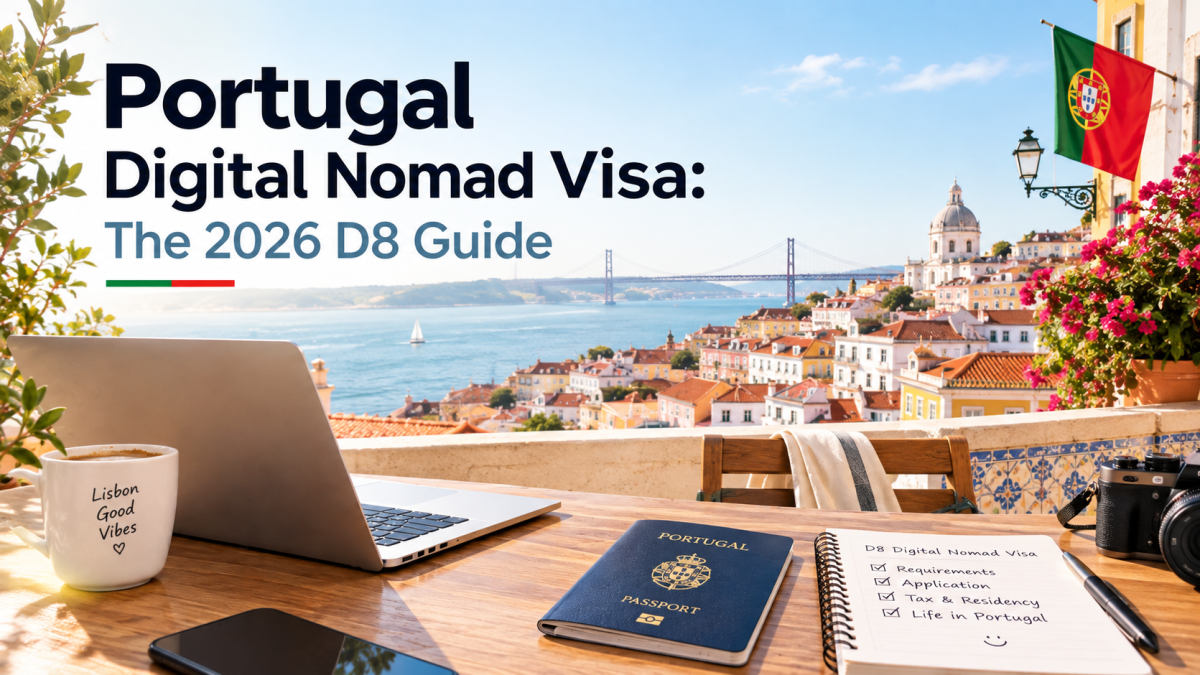
Few destinations balance “serious remote-work infrastructure” and “genuinely restorative scenery” quite like Portugal does. The Portugal digital nomad visa — officially the D8 — has already drawn over 2,600 remote workers since its October 2022 launch, according to imin-Portugal’s 2026 guide, with American, Brazilian, and British applicants leading the numbers. Here’s what’s changed for 2026 and what the route actually offers.
The Updated 2026 Income Requirement
Portugal’s minimum wage rose to €920 per month in 2026, and because the D8 threshold is fixed at four times that figure, the current income requirement is €3,680 per month, according to Global Law Experts’ 2026 breakdown. That’s up from the €3,480 figure widely cited in older 2025 guides — worth flagging, since outdated numbers still circulate online. On top of income, Immigrant Invest’s guide confirms applicants must also show savings of at least €11,040 (12 times the minimum wage), with that figure rising by €5,520 per additional adult and €3,312 per child included in the application.
Your income has to come from outside Portugal — a foreign employer, international clients, or freelance work billed to entities based abroad all qualify, per Global Citizen Solutions’ June 2026 guide, which notes eligible applicants range from software developers to researchers, project managers, and financial analysts.
Two Visa Tracks, Different Purposes
The D8 actually comes in two forms, per imin-Portugal’s guide. A temporary stay visa lets you “test-drive” life in Portugal for up to a year with multiple entries, without building toward residency — useful if you’re not fully committed yet. The residency visa track is the one that actually leads somewhere: an initial 2-year residence permit, renewable for a further 3 years, eventually opening the door to permanent residency and citizenship.
The Real Path to EU Citizenship
This is arguably the D8’s strongest long-term selling point compared to destinations like Thailand or Bali. According to Global Citizen Solutions, D8 holders can apply for permanent residency after 5 years of legal residence, and for Portuguese citizenship after 10 years (reduced to 7 years for EU and CPLP-country citizens). Along the way, residence permit holders also get access to Portugal’s public healthcare and education systems, including free access to public schools and universities, per imin-Portugal’s separate guide.
Timeline and Cost
Processing generally takes 30 to 90 days once your documents are submitted, according to Get Golden Visa’s 2026 guide, though D7Visa’s Braga-based guidance notes the full journey — from initial application to actually relocating — can realistically take around 6 months once you factor in appointment availability and the conversion step through AIMA (Agência para a Integração, Migrações e Asilo), the Portuguese immigration agency that finalizes your residence permit after you arrive.
The Nature That Makes This Worth It
This is where Portugal earns its reputation beyond the paperwork. The Algarve’s whitewashed cliffs and quiet coves have become the default choice for remote workers wanting ocean views without Lisbon’s density. Madeira has gone further, building a dedicated Digital Nomad Village specifically to welcome remote workers into its subtropical hiking trails and levada walking paths carved through volcanic mountainside. The Azores, further out in the Atlantic, offer something closer to raw wilderness — volcanic crater lakes, whale-watching waters, and a population small enough that daily life still feels unhurried. For remote workers who want their relocation to feel like an actual reset rather than just a change of city, Portugal’s geography does a lot of the work on its own.
How Portugal Compares to Other Options We’ve Covered
If you’re weighing this against other legitimate options, our best digital nomad countries roundup places Portugal among the top-ranked programs globally, largely because of this exact combination: a genuine path to EU citizenship, mature infrastructure, and restorative scenery in the same package. Compared to our Colombia digital nomad visa guide, Portugal’s income bar is notably higher, but it offers something Colombia explicitly doesn’t — a real route to long-term EU residency rather than a temporary, non-renewing-toward-residency stay. And compared to our New Zealand digital nomad guide, Portugal trades New Zealand’s visa-free simplicity for a structured, citizenship-track program instead.
The Bottom Line
The Portugal digital nomad visa remains one of the strongest long-term options in Europe for remote workers who can clear the 2026 income threshold — not just for the visa mechanics, but for what it actually leads to: a genuine path to EU citizenship, paired with some of the continent’s most restorative coastal and island scenery. If you’re deciding between a short-term reset and a genuine long-term relocation plan, Portugal is built for the second option.
Sources:
- imin-Portugal — Portugal Digital Nomad Visa (D8) Guide, December 2025
- imin-Portugal — Portugal Digital Nomad Visa (D8) in 2026, June 2026
- Global Law Experts — Portugal D8 Visa Requirements 2026, June 2026
- Immigrant Invest — Portugal Digital Nomad Visa, 2026 update
- Global Citizen Solutions — Portugal Digital Nomad Visa: D8 Guide, June 2026
- Get Golden Visa — Portugal D8 Digital Nomad Visa 2026 Guide, August 2026
- D7Visa — Portugal D8 Digital Nomad Visa 2026: Applications, Cost & Validity, August 2026


Leave a Reply