Countries Hiring Foreign Workers: Where International Job Seekers Should Look First
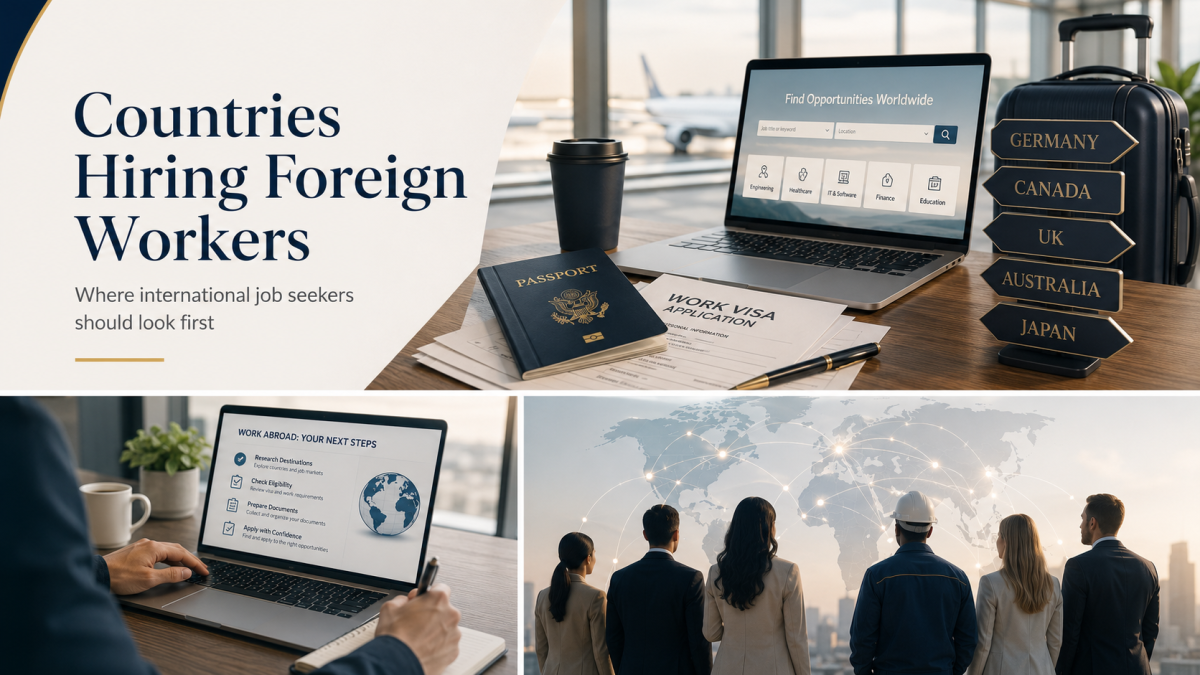
Countries hiring foreign workers are not always the countries people talk about most on social media.
Some destinations look glamorous online but are extremely difficult for international applicants. Others are less flashy but have clearer work routes, official job portals, employer sponsor lists, or skilled-worker programs that can help serious candidates research real opportunities.
For job seekers from Indonesia, India, Nigeria, South Africa, Kenya, Pakistan, the Philippines, Ghana, Bangladesh, and other developing countries, the goal should not be chasing random “work abroad” promises.
The goal should be smarter.
Find countries where your occupation, experience, documents, language ability, and employer strategy have a realistic chance of matching the official system.
That is what this guide is about.
We will compare countries hiring foreign workers across North America, Europe, Asia-Pacific, and Japan. We will also explain which applicants may fit each route, what to check before applying, and how to avoid job scams that target people who dream of working overseas.
If you are still building your job search, you can browse international opportunities through ISKCON of Escondido Jobs and use this guide to evaluate which countries and roles may be worth deeper research.
Why Countries Hire Foreign Workers
Countries hire foreign workers for different reasons.
Some need skilled professionals because local employers cannot fill certain roles quickly enough. Others need seasonal workers, healthcare workers, engineers, IT specialists, construction workers, teachers, hospitality staff, caregivers, or tradespeople.
Common reasons include:
- Labour shortages
- Ageing populations
- Skills gaps
- Regional worker shortages
- Healthcare demand
- Infrastructure projects
- Technology growth
- Seasonal industries
- International business expansion
- Need for multilingual workers
However, a country needing workers does not mean every foreign applicant automatically qualifies.
You still need to match the rules.
That usually means checking:
- Occupation eligibility
- Salary requirements
- Employer sponsorship
- Work-permit rules
- Language requirements
- Qualification recognition
- Professional licensing
- Health and character requirements
- Visa fees and processing time
- Whether the employer is legitimate
A good overseas job search starts with official information, not viral videos.
The Two Types of Countries Hiring Foreign Workers
Before choosing a destination, understand the difference between two types of routes.
Employer-First Countries
In employer-first systems, you usually need a job offer before applying for a work visa or permit.
This means the employer may need to sponsor, nominate, or support your application.
Examples include:
- United Kingdom Skilled Worker visa
- Canada employer-specific work permit
- New Zealand Accredited Employer Work Visa
- Australia Skills in Demand visa
- Ireland Critical Skills Employment Permit
- Many Japan work routes
These routes can be powerful because you may move with a job already arranged.
But the hard part is getting the employer first.
Visa-First or Job-Search-Friendly Countries
Some routes may allow eligible applicants to enter first or search for jobs more directly.
Examples include:
- Germany Opportunity Card
- UAE Jobseeker Visit Visa
- Some graduate or job-search pathways
These routes can reduce the “I need a job to get a visa, but I need a visa to get a job” problem.
However, they create financial risk because you may need to support yourself while searching.
The right route depends on your profile.
1. Germany: Strong for Skilled Workers, Engineers, IT, Healthcare, and Trades
Germany is one of the most practical countries hiring foreign workers because it has official tools for skilled migration and job search.
The German government’s official portal, Make it in Germany, provides guidance for qualified professionals who want to work in Germany.
Germany may be relevant for applicants in:
- Engineering
- IT
- Healthcare
- Nursing
- Skilled trades
- Manufacturing
- Logistics
- Science
- Technical services
- Vocational occupations
One attractive route is the Germany Opportunity Card, which allows eligible third-country workers to enter Germany to seek employment.
Applicants can also use the official Opportunity Card self-check to assess whether they may qualify.
Who Should Consider Germany?
Germany may be realistic if you have:
- A recognized academic or vocational qualification
- Work experience in a needed occupation
- German or English language ability
- Enough savings
- A clear target occupation
- Documents that can be verified
- Willingness to handle recognition or licensing processes
German language ability can make a huge difference.
Some tech roles may work in English, but healthcare, trades, public-facing jobs, and many regional employers may require German.
Germany Reality Check
Before focusing on Germany, ask:
- Is my qualification recognized?
- Does my job require professional licensing?
- Can I prove my work experience?
- Do I need German language certification?
- Is my occupation actually in demand?
- Can I support myself during a job search?
- Am I applying through official channels?
Germany can be a strong destination, but it rewards prepared applicants more than hopeful ones.
2. Canada: Good for Foreign Workers With Real Employers and LMIA-Based Roles
Canada is one of the most searched destinations for people looking for overseas work.
It can be attractive because of its strong economy, immigration pathways, and demand in several industries. But it is also one of the countries where job seekers must be careful with fake offers.
Canada’s official Job Bank for temporary foreign workers lists jobs from Canadian employers that have obtained or applied for a Labour Market Impact Assessment, commonly called an LMIA.
Canada also provides official guidance on employer-specific work permits.
Canada may be relevant for applicants in:
- Healthcare
- Skilled trades
- Agriculture
- Food services
- Hospitality
- Trucking and logistics
- Construction
- Technology
- Care work
- Manufacturing
- Retail supervision
- Regional roles
Who Should Consider Canada?
Canada may be realistic if you have:
- A genuine job offer
- Relevant work experience
- A role that matches employer demand
- Proper documentation
- Language ability
- Willingness to work outside major cities
- Understanding of LMIA or work-permit requirements
Canada can be competitive, especially for applicants targeting big cities only.
Some candidates may find more realistic opportunities in smaller provinces, regional areas, or industries with persistent labour shortages.
Canada Reality Check
Before trusting a Canadian job offer, ask:
- Is the employer real?
- Is the job posted on an official or reputable platform?
- Does the employer need an LMIA?
- Has the employer obtained or applied for an LMIA?
- Is the employer listed as non-compliant?
- Am I being asked to pay for the job?
- Are the salary and duties realistic?
- Is the recruiter using a real company email?
Never pay for a guaranteed Canadian job offer.
A real employer should not sell you a job.
3. United Kingdom: Strong for Skilled Roles, But Sponsorship Must Be Real
The United Kingdom can be attractive for healthcare workers, IT professionals, engineers, teachers, researchers, finance professionals, and other skilled applicants.
But the UK is not simply “apply and move.”
The employer usually needs to be approved as a sponsor, the job must be eligible, and salary rules must be met.
The official GOV.UK Register of Licensed Sponsors lists employers licensed to sponsor workers.
Applicants should also check the GOV.UK Skilled Worker visa and Skilled Worker job eligibility pages.
Who Should Consider the UK?
The UK may be realistic if you work in:
- Healthcare
- Nursing
- Care roles
- Engineering
- Software development
- Education
- Science
- Finance
- Architecture
- Professional services
- Skilled occupations on eligible lists
However, being hired by a sponsor is not automatic.
A company appearing on the sponsor register means it is licensed. It does not mean every job includes sponsorship.
UK Reality Check
Before applying, check:
- Is the employer on the sponsor register?
- Is the role eligible?
- Does the salary meet the required threshold?
- Is the occupation code correct?
- Does the job ad mention sponsorship?
- Does the employer sponsor this role type?
- Do I meet English and documentation requirements?
Be careful of people selling Certificates of Sponsorship.
A Certificate of Sponsorship must be linked to a genuine job with a licensed employer.
4. Australia: Strong for Skilled Workers, Trades, Healthcare, and Regional Roles
Australia remains attractive for skilled workers because of its salaries, lifestyle, and labour needs across several sectors.
The official Australian Department of Home Affairs provides the Skilled Occupation List, which helps applicants understand which occupations may be relevant to skilled visa pathways.
For employer sponsorship, the Skills in Demand visa subclass 482 Core Skills stream enables employers to address labour shortages by bringing in skilled workers where they cannot source suitable Australian workers.
Australia may be relevant for:
- Healthcare
- Nursing
- Engineering
- Construction
- Trades
- Education
- IT
- Agriculture
- Regional occupations
- Mining-related services
- Professional services
Who Should Consider Australia?
Australia may be realistic if you have:
- A skilled occupation
- Strong work experience
- English ability
- Qualifications that can be assessed
- Potential employer sponsorship
- Licensing readiness
- Willingness to consider regional locations
Australia can be strict about documentation.
Skills assessments, English tests, licensing, health checks, and character checks may be part of the process depending on the visa type.
Australia Reality Check
Before focusing on Australia, ask:
- Is my occupation on a relevant list?
- Do I need a skills assessment?
- Do I need professional registration?
- Can I meet the English requirement?
- Is the employer allowed to sponsor?
- Does the salary meet the required level?
- Which costs are mine and which are employer costs?
A beautiful country does not remove the need for a strong application.
5. New Zealand: Easier to Verify Employers Through the Accredited Employer List
New Zealand can be attractive for skilled workers who want a smaller, quieter, and highly organized destination.
One advantage is that Immigration New Zealand provides an official accredited employer list, which helps applicants verify employers approved to hire overseas workers under relevant skilled work visa categories.
The official Accredited Employer Work Visa page explains that applicants need a job offer from an accredited employer.
New Zealand may be relevant for:
- Healthcare
- Aged care
- Construction
- Engineering
- Agriculture
- Hospitality
- Education
- Trades
- IT
- Regional roles
Who Should Consider New Zealand?
New Zealand may be realistic if you have:
- A genuine full-time job offer
- Relevant experience
- An accredited employer
- Required qualifications
- English ability when required
- Health and character documents
- Willingness to work outside the biggest cities
It can be especially useful for applicants who want to verify employers before getting too emotionally invested.
New Zealand Reality Check
Before trusting a job offer, ask:
- Is the employer on the accredited employer list?
- Is the role full-time?
- Does the job meet visa requirements?
- Are pay and hours clearly stated?
- Does the employer communicate professionally?
- Am I being asked to pay for a job?
- Can I verify the business independently?
Immigration New Zealand warns applicants about immigration scams, so always verify through official sources.
6. Ireland: Strong for Critical Skills and English-Speaking Professionals
Ireland is attractive because it is English-speaking, connected to the European economy, and home to many global companies in technology, pharmaceuticals, finance, medical devices, and professional services.
Ireland’s Critical Skills Employment Permit is designed to attract highly skilled workers into occupations that are important to the Irish economy.
Ireland may be relevant for:
- IT
- Engineering
- Healthcare
- Science
- Finance
- Medical devices
- Pharmaceuticals
- Professional services
- International sales
- Education specialties
Who Should Consider Ireland?
Ireland may be realistic if you have:
- A qualifying job offer
- A role on the critical skills list
- Relevant qualifications
- Salary matching permit rules
- Strong English
- Professional experience
- Employer readiness
Ireland can be attractive for applicants who want English-speaking work in Europe, but housing costs and salary thresholds must be considered carefully.
Ireland Reality Check
Before applying, check:
- Is the occupation eligible?
- Does the salary meet the rule?
- Is the employer genuine?
- Is the job offer long enough?
- Are qualifications acceptable?
- Are housing costs realistic?
- Does the role match your actual experience?
Do not focus only on “Ireland visa sponsorship.”
Focus on exact roles and employers.
7. Japan: Good for Skilled Workers, But Language and Route Matter
Japan is attractive for many international applicants because of its economy, technology, culture, safety, and demand in certain sectors.
Japan’s official Specified Skilled Worker Program support site provides information for people interested in employment under the Specified Skilled Worker system.
Japan’s Ministry of Foreign Affairs also explains that the Specified Skilled Worker status was established to welcome capable overseas specialists into certain industrial fields.
Japan may be relevant for:
- Care work
- Manufacturing
- Construction
- Agriculture
- Food service
- Hospitality
- Shipbuilding-related work
- Automotive maintenance
- Aviation-related roles
- IT and engineering through other skilled routes
Who Should Consider Japan?
Japan may be realistic if you have:
- Relevant skills
- Willingness to learn Japanese
- Ability to pass required tests
- Interest in specific industries
- Real employer support
- Patience with documentation
- Cultural adaptability
Japanese language can be a major advantage.
Even when a job technically accepts foreign workers, daily life and workplace success may be much easier with Japanese ability.
Japan Reality Check
Before focusing on Japan, ask:
- Which visa route applies?
- Do I need Japanese language testing?
- Do I need a skills test?
- Is the employer real?
- Is the industry still accepting applicants?
- Are there caps or changing rules?
- What support does the employer provide?
Japan can be a strong option, but it is not a shortcut.
It requires preparation.
8. Europe Through EURES: Useful Research, But Rules Vary by Country
Europe is not one single immigration system for non-EU applicants.
Germany, Ireland, the Netherlands, Finland, Poland, Portugal, Czechia, France, Spain, and other countries each have different rules.
Still, the official EURES portal can be useful for researching European job opportunities and labour-market demand.
EURES is especially useful for understanding:
- Which countries are posting jobs
- Which sectors are hiring
- Which skills appear repeatedly
- Which languages are requested
- Which regions need workers
- Which employers are active
Who Should Use EURES?
EURES can help applicants who want to compare opportunities across Europe in areas like:
- Healthcare
- Engineering
- IT
- Hospitality
- Manufacturing
- Logistics
- Construction
- Research
- Education
- Skilled trades
However, finding a job post on a European portal does not automatically mean a non-EU applicant can work there.
You must still verify the country-specific visa and work-permit route.
Europe Reality Check
Before applying across Europe, ask:
- Which country is the job in?
- Does that country sponsor non-EU workers?
- Is my occupation eligible?
- Is my qualification recognized?
- Which language is required?
- Does the employer hire internationally?
- What salary threshold applies?
- Does the job lead to a work permit?
Europe can be full of opportunity, but vague research creates confusion.
Pick two or three countries and go deeper.
9. United Arab Emirates: Fast-Moving Market for Experienced Professionals
The United Arab Emirates can be attractive for applicants who want international experience in the Middle East.
The UAE is a major employment market in:
- Hospitality
- Aviation
- Logistics
- Finance
- Real estate
- Technology
- Construction
- Sales
- Healthcare
- Retail
- Professional services
The UAE also has a Jobseeker Visit Visa, which may allow eligible applicants to enter the country to explore job opportunities without requiring a host or sponsor.
Who Should Consider the UAE?
The UAE may be realistic if you have:
- Strong English
- Relevant professional experience
- Middle East market awareness
- A clear target role
- Enough savings
- Interview opportunities
- A strong résumé
- Ability to move quickly
The UAE can move faster than some Western immigration systems, but that speed also creates scam risk.
UAE Reality Check
Before travelling, ask:
- Do I qualify for the correct visa?
- Do I have enough savings?
- Are interviews already scheduled?
- Is the recruiter licensed or verifiable?
- Is the employer real?
- Are salary and benefits written?
- Is accommodation included or separate?
- Will I receive proper work authorization before starting?
Do not arrive because a stranger says:
Come here first, then we guarantee you a job.
That is not a strategy.
That is risk.
Best Countries by Applicant Profile
Different candidates should target different countries.
If You Are in IT or Software
Consider researching:
- Germany
- United Kingdom
- Canada
- Ireland
- Australia
- New Zealand
- Japan
- Remote-first global companies
Your biggest advantage is proof.
Build:
- GitHub
- Portfolio
- Live projects
- Technical case studies
- Certifications
- Strong LinkedIn profile
If You Are in Healthcare
Consider researching:
- United Kingdom
- Canada
- Germany
- Ireland
- Australia
- New Zealand
- Japan for specific care pathways
Your biggest challenge may be licensing.
Prepare:
- Qualification documents
- Experience letters
- Language tests
- Professional registration
- Credential assessment
- References
If You Are in Skilled Trades
Consider researching:
- Germany
- Australia
- Canada
- New Zealand
- Japan
- Some European countries
Your biggest challenge may be recognition and documentation.
Prepare:
- Trade certificates
- Employment records
- Skills evidence
- Safety certificates
- Licensing documents
- Photos of work where appropriate
- Employer references
If You Are in Customer Support or BPO
Consider researching:
- Remote global companies
- UAE
- UK support roles where eligible
- Ireland customer operations
- Canada regional support roles
- International SaaS companies
Your biggest advantage is communication.
Prepare:
- English writing samples
- CRM tool experience
- Customer satisfaction metrics
- Ticket-volume numbers
- Remote setup proof
- Time-zone availability
If You Are in Hospitality
Consider researching:
- UAE
- Canada
- Australia
- New Zealand
- Japan
- Ireland
Your biggest advantage is experience and service quality.
Prepare:
- Employer references
- Training certificates
- English ability
- Role-specific experience
- Customer-service proof
- Willingness to work in regional areas
How to Choose the Right Country
Do not choose only based on salary.
Use this scoring method.
Score each country from 0 to 2.
Occupation Fit
- 0: My occupation is not clearly needed.
- 1: Some related roles exist.
- 2: My occupation clearly appears in official or employer demand.
Employer Access
- 0: I cannot find real employers.
- 1: Employers exist but sponsorship is unclear.
- 2: I can identify real sponsors, accredited employers, or official job listings.
Qualification Fit
- 0: My qualifications likely do not match.
- 1: Recognition is uncertain.
- 2: My qualifications clearly fit or can be recognized.
Language Fit
- 0: I do not meet the language requirement.
- 1: I may meet the minimum.
- 2: I can work confidently in the required language.
Financial Readiness
- 0: I cannot afford the process.
- 1: I can afford basic costs only.
- 2: I can afford fees, documents, waiting time, and emergency travel.
Scam Risk Control
- 0: I depend on an unverified agent.
- 1: I have some official information.
- 2: I can verify employer, visa route, and documents through official sources.
Score Meaning
0–4
Do not spend money yet. Research more.
5–8
Possible, but needs preparation.
9–11
Potentially realistic with targeted applications.
12
Strong route to investigate seriously.
This is not a guarantee.
It is a decision tool.
How to Avoid Fake Overseas Job Offers
Job scams are common because scammers know people want a better life.
The U.S. Federal Trade Commission warns that honest employers will not ask you to pay to get a job.
Be careful if someone says:
- Pay first, job later
- Guaranteed visa
- No interview needed
- Salary is very high for simple work
- Only WhatsApp communication
- Personal bank account payment
- Crypto payment required
- “Government slot” available today only
- Fake-looking offer letter
- Passport requested too early
- Recruiter refuses video call
- Company website looks copied
- Email address is Gmail/Yahoo instead of company domain
A real job can handle verification.
A scam usually pressures you to move fast.
The Safe Application System
Use this simple system before applying or paying anything.
Step 1: Verify the Country Route
Use official government sources.
Examples:
- GOV.UK for the UK
- Canada.ca and Job Bank for Canada
- Make it in Germany for Germany
- Australian Home Affairs for Australia
- Immigration New Zealand for New Zealand
- SSW Japan for Japan
- EURES for Europe
Step 2: Verify the Employer
Check:
- Official website
- Company email domain
- LinkedIn page
- Business registration where available
- Sponsor or accredited-employer list
- Job listing on the company site
- Real recruiter identity
Step 3: Verify the Job
Check:
- Job title
- Duties
- Salary
- Location
- Working hours
- Contract type
- Visa support
- Benefits
- Accommodation if offered
- Who pays which fees
Step 4: Verify the Money
Ask:
- Am I being asked to pay for the job?
- Is payment going to a personal account?
- Are fees clearly official?
- Can I pay government fees directly?
- Is the recruiter hiding fee details?
If someone wants money before you can verify anything, stop.
Step 5: Track Everything
Use a spreadsheet.
Record:
- Country
- Employer
- Job title
- Official route
- Source link
- Application date
- Recruiter name
- Follow-up date
- Status
- Red flags
A serious job search needs a system.
Hope is not enough.
The Smartest Strategy for Job Seekers From Developing Countries
If you are starting from Indonesia, India, Nigeria, South Africa, Kenya, Pakistan, the Philippines, or another developing country, do not try to chase every country at once.
Choose three target countries.
For each country, identify:
- Your best occupation match
- Official visa route
- Real employers
- Required documents
- Salary rules
- Language requirements
- Scam risks
- Application timeline
Then choose one primary country and one backup country.
This keeps the process focused.
For example:
- An Indonesian software developer may compare Germany, Canada, and Singapore.
- A Filipino nurse may compare the UK, Ireland, and Australia.
- A Nigerian customer success professional may compare remote global roles, Ireland, and the UAE.
- A South African engineer may compare Australia, New Zealand, and the UK.
- An Indian hospitality worker may compare UAE, Canada, and Japan.
- A Kenyan support specialist may compare remote jobs, UK care roles, and Canada regional employers.
Your nationality does not define your future.
But your strategy must match your documents, skills, language, and budget.
Final Thoughts on Countries Hiring Foreign Workers
Countries hiring foreign workers can create real opportunities.
But the opportunity is not the same for everyone.
The strongest applicants do not chase random promises.
They study official rules.
They match their occupation to real demand.
They verify employers.
They prepare documents early.
They build proof of experience.
They avoid people selling guaranteed jobs.
They apply with patience and structure.
If you want to work in the United States, Canada, Europe, Australia, New Zealand, Japan, Germany, Ireland, the United Kingdom, or the UAE, start with one honest question:
Which country has a real route for someone with my occupation, experience, language ability, and documents?
That question is more powerful than asking:
Which country is easiest?
Easy is usually a trap.
Realistic is better.
Use official sources, compare real job listings, and build your plan one step at a time.
You can begin by exploring international job listings on ISKCON of Escondido Jobs, then verify every serious opportunity through the official government sources listed below.
A global career is possible.
But it is built through preparation, not panic.
Frequently Asked Questions About Countries Hiring Foreign Workers
Which countries are hiring foreign workers?
Countries such as Germany, Canada, the United Kingdom, Australia, New Zealand, Ireland, Japan, the UAE, and several European countries may hire foreign workers in eligible occupations. Requirements vary by country, employer, visa route, salary, and occupation.
Which country is easiest to get a work visa?
There is no single easiest country. The best option depends on your occupation, qualifications, work experience, language ability, savings, and whether you can secure an eligible employer.
Can I get a foreign job without paying an agent?
Yes. Many applicants can apply directly through employer websites, official job portals, government resources, or legitimate recruitment channels. You should be cautious of anyone demanding money in exchange for a guaranteed job.
Which countries hire workers from Indonesia?
Indonesian applicants may research Japan, Germany, Australia, Canada, New Zealand, the UAE, Singapore, and remote global employers, depending on their occupation and documents.
Which countries hire workers from India?
Indian applicants may research Canada, Germany, the UK, Ireland, Australia, New Zealand, Japan, the UAE, and remote global companies. Applicants should verify employers carefully because job scams are common.
Which countries hire workers from Nigeria?
Nigerian applicants may research Canada, the UK, Germany, Ireland, the UAE, Australia, and remote-first companies, depending on occupation, qualifications, and employer eligibility.
Which countries hire workers from the Philippines?
Filipino applicants may research Japan, Canada, the UK, Ireland, Australia, New Zealand, Germany, the UAE, and international remote roles, depending on their professional background.
Can remote work lead to overseas employment?
Sometimes. Remote work can help build international experience and employer trust, but it does not automatically create a visa route. Sponsorship depends on the employer, country, role, salary, and immigration rules.
How do I know if a foreign employer is real?
Check the company website, official email domain, recruiter profile, government sponsor list, accredited-employer list, business registration, job posting source, and whether the offer requires payment.
Should I pay for a guaranteed overseas job?
No. Be extremely cautious. Honest employers do not usually require applicants to pay for a job. Use official government sources and avoid anyone promising guaranteed visa approval.
Official Sources and Useful Links
- GOV.UK Register of Licensed Sponsors
- GOV.UK Skilled Worker Visa
- Canada Job Bank: Temporary Foreign Workers
- Canada Employer-Specific Work Permit
- Make it in Germany
- Germany Opportunity Card
- Australia Skilled Occupation List
- Australia Skills in Demand Visa
- New Zealand Accredited Employer Work Visa
- New Zealand Accredited Employer List
- Ireland Critical Skills Employment Permit
- Japan Specified Skilled Worker Program
- Japan Ministry of Foreign Affairs: Specified Skilled Worker
- EURES European Job Mobility Portal
- UAE Jobseeker Visit Visa
- FTC: Job Scams
- ISKCON of Escondido Jobs



Leave a Reply